

FMCG Product Sampling Gamification: Turn Free Samples Into Data
A promoter hands out 500 free samples in a supermarket aisle over one morning shift. How many shoppers actually try the product? How many even remember the brand name by the time they reach the checkout? And how much usable contact data does the brand walk away with? For most sampling activations, the honest answer is: nobody knows, and almost none.
That's the structural problem with traditional FMCG sampling — it reaches a lot of people but converts almost nothing into measurable, follow-up-able data. Gating the sample redemption behind a product QR scan and a spin-to-win mechanic fixes this at the root, and it's exactly the kind of use case FMCG marketing teams in Vietnam are increasingly running through gamification platforms like LuckyWheel.
Want to run a similar program?
See a real prize wheel running right in your browser.
The classic sampling problem: wide reach, almost no usable data
Sampling has always been one of FMCG's most reliable trade marketing tools — and one of the hardest to actually measure. The gap shows up in three places:
- No intent signal: someone taking a free sample off a table may be walking past out of curiosity, not because they have any real purchase intent. There's no filter between "took it for free" and "actually cares about the product."
- No usable contact data: a paper sign-up sheet at the booth, if there's one at all, gets skipped, filled out illegibly, or duplicated across shifts. There's no reliable way to follow up with the person who took the sample to see if they went on to buy.
- No funnel visibility: marketing teams rarely know how many samples were actually handed out, how many people engaged further with the brand, or what the real ROI of the activation was — the numbers that go into a report to management are often best guesses.
None of this is a promoter-team failure. It's a structural limitation of the mechanic itself: a free sample is a one-way handoff. There's no step in between "here's a free sample" and "walk away" where the brand can capture a name, a phone number, or even confirmation that the person actually opened the product. By the next aisle, most samples are forgotten, and the brand has no way of finding out whether that forgetting happened or not.
These are the same pain points that show up across most under-engineered trade activation setups: booths people walk past without engaging, lead data that's duplicated or unusable, and no real ROI numbers to report once the campaign wraps.
Gating the spin behind a product QR scan changes the mechanic
Instead of handing a free sample directly to whoever walks by, a QR-gated sampling mechanic flips the sequence: the shopper has to physically pick up the product, find the QR code on the packaging, and scan it before a spin unlocks at all. That single change in order does most of the work.
Here's why it matters:
- A real intent signal happens before the reward: scanning requires the shopper to physically handle the product — pick it up, locate the code, scan it — which is a meaningfully stronger signal of interest than simply reaching for something free on a table.
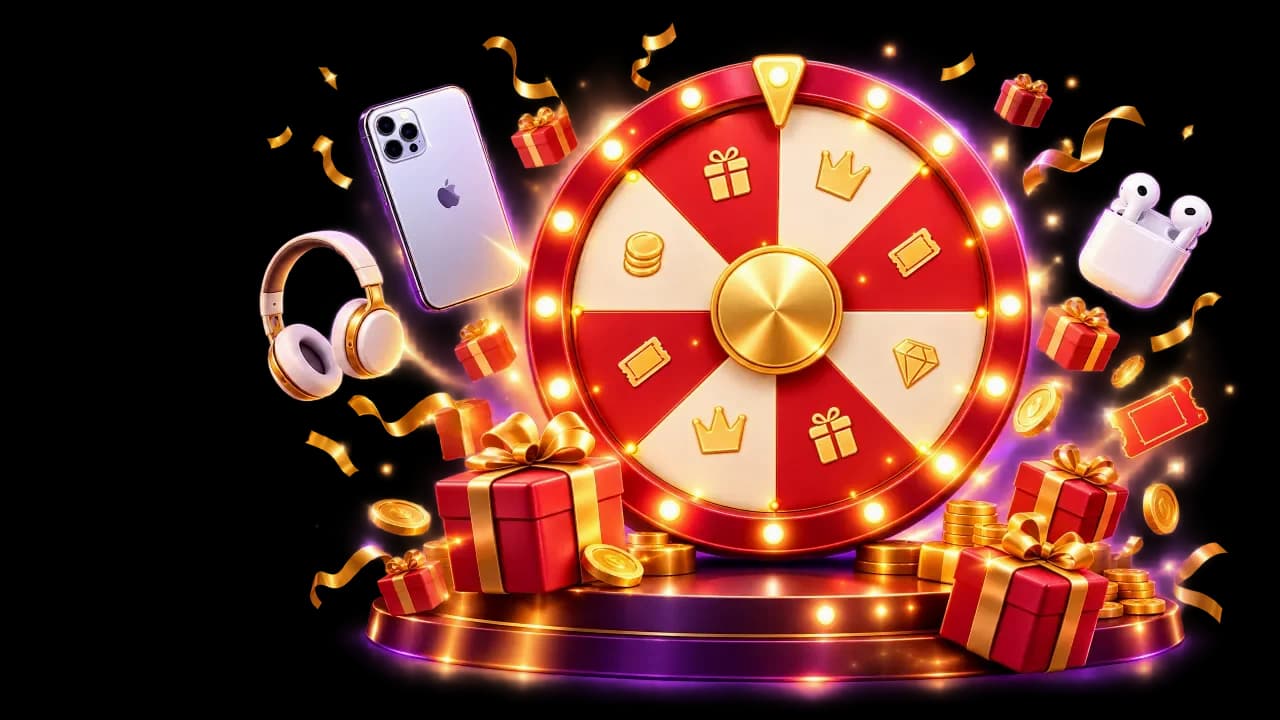
- The play itself is instant and frictionless: this is LuckyWheel's core mechanic — scan a QR code, play instantly on the shopper's own phone, no app install, with the prize revealed in around 3 seconds ("Instant Play"). The draw logic runs server-side, so the outcome can't be tampered with and every result is auditable.
- A real name and phone number get captured inside the spin flow: to claim a prize, the shopper enters their name and phone number as part of the spin itself — data that's noticeably cleaner than a clipboard sign-up sheet, because it's captured digitally and tied directly to the specific product scan that unlocked it.
What this buys the brand: cleaner data, funnel visibility, prize control
Once sampling runs on a scan-then-spin gate, the brand isn't just adding an engaging minigame — it gains three concrete operational advantages.
Cleaner lead data than a clipboard ever produced
Every completed spin is tied to a product scan and a phone number entered directly into the system — no illegible handwriting, no sign-up sheets lost between shifts. That data exports cleanly to CSV, ready for the CRM or sales team the moment the activation ends.
Real-time visibility into how many samples actually convert
A live dashboard shows participant count, lead count, and conversion percentage while the campaign is still running — meaning the marketing team can see exactly how many product scans turned into a completed spin, instead of reconstructing the funnel manually after the fact. When the campaign closes, an ROI report is generated automatically, removing the all-night manual data work that FMCG marketing directors running these activations know all too well.
Prize-tier control that keeps the crowd happy and still creates buzz
Brands can weight the prize mix so that most participants win small, guaranteed gifts — keeping the experience positive for the volume of people who scan and spin — while reserving a handful of bigger prizes to generate word-of-mouth. Auto-locking VIP prizes and precise odds control mean the big-ticket item doesn't get won and gone in the first hour, or sit unclaimed all day.
A real example of exactly this buy-and-spin mechanic tied to a specific SKU is Neutrogena's "Sunshine Wheel" campaign, where shoppers bought the Ultra Sheer SPF50 sunscreen to unlock a spin for summer-themed prizes. It's a useful reference point for how a single, well-defined purchase trigger can carry an entire sampling-and-loyalty mechanic.
Running it across multiple booths and locations at once
FMCG sampling campaigns rarely run at a single location — they typically span multiple promoter booths across supermarkets, convenience stores, or malls simultaneously. That's where the operational risk shows up: if each booth manages its own prize pool independently, a high-traffic location can burn through the big prizes within the first few hours, leaving other booths with nothing left worth scanning for.
LuckyWheel addresses this with centralized multi-screen, multi-booth, multi-wheel management and role-based permissions, which in practice means:
- The entire prize inventory is managed from one central system, shared across every booth rather than siloed per location.
- No single booth can accidentally drain prizes meant for the rest of the network.
- Campaign settings — odds, remaining prize counts — can be adjusted centrally, mid-event, without taking anything offline.
- The platform stays reliable even on flaky venue wifi, thanks to local-first, offline-capable operation and a 99.9% uptime commitment.
For a sampling program running across several cities or retail chains at once, this is the difference between a controlled campaign and a promoter team firefighting over group chat all day. Booth staff also don't need to be system administrators to run it — campaigns are configured centrally by the marketing team, with role-based access so a promoter can operate the spin at their booth without touching prize logic or campaign-wide settings.
Building it into a broader sampling strategy
Gamifying sampling doesn't replace the fundamentals of a good activation — the right product, the right footfall location, a promoter team that can actually explain what's being sampled. What it changes is what happens after the sample leaves the brand's hands. Instead of a one-way giveaway, the QR-scan-then-spin structure creates a checkpoint: a moment where the shopper's action (scanning, picking up the product) and the brand's data capture (name, phone number) happen in the same flow, before any prize is handed over.
That checkpoint is what makes the rest of the campaign measurable. Marketing directors can report actual scan-to-spin conversion instead of an estimated reach number, sales teams get a real list to follow up with, and the brand walks away from the activation with something more durable than a stack of used sample cups.
Where to start
Sampling doesn't have to mean handing out product and hoping. Gate the redemption behind a product QR scan and a spin-to-win mechanic, and every sample handed out becomes a data point: who picked up the product, who left a real phone number, and who's worth a sales follow-up after the campaign ends.
See the scan-and-play-in-3-seconds mechanic for yourself in the LuckyWheel demo, or check pricing to plan your next sampling activation.